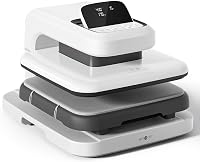
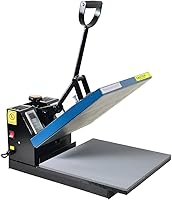
9 Best Heat Press Machines for Embroidered Patches (November 2026)
The best heat press machines for embroidered patches include the Calogy Mini Heat Press for small patches on finished garments, the Delclynee Hat Heat Press Machine for Caps for patches on structured caps, and the VEVOR 4-in-1 Heat Press Machine for Hats for mixed hat shapes.
On this page (8 sections)
- Which heat press works best for embroidered patches?
- How these heat press machines for embroidered patches compare
- What plate size do you need for embroidered patches?
- Do you need a swing away or clamshell press for patch work?
- What temperature and pressure do embroidered patches need?
- How do you press a patch onto a cap or a curved surface?
- Which heat press suits a small craft business?
- Verdict
The best heat press machine for embroidered patches on most garments is the Calogy Mini Heat Press, because its 2.87 x 4.43 in plate lands on the patch and leaves the shirt around it alone. For caps, the Delclynee Hat Heat Press is the better tool, and the HTVRONT Auto Heat Press 2 takes over when a patch is big or the jacket is thick.
Patch work splits into two jobs. Small patches on a finished shirt or bag need a plate that fits inside the patch outline.
Hats and thick garments need a curved platen or real clamping pressure.
A heat press machine for embroidered patches also has to reach the adhesive's activation temperature quickly, because a long press under a small plate can leave a shiny mark on the fabric. The picks below cover both jobs, sorted by score.
Our picks at a glance
-
1

-
2
 Best for patches on structured caps
Delclynee Hat Heat Press Machine for Caps
9.3/10 our score
See it on Amazon -
3
 Best for mixed hat shapes
VEVOR 4-in-1 Heat Press Machine for Hats
9.1/10 our score
See it on Amazon
- 4
 Check it
Calogy Super Mini Heat Press Machine
Best for tiny patches and corners - 5
 Check it
HTVRONT Auto Heat Press 2 15x15
Best for patch-covered backs and jackets - 6
 Best for batches of patched shirtsCheck it
- 7
 Check it
Delclynee 15x15 High Pressure Clamshell
Best for heavy pressure on flat work - 8
 Best for guided auto pressingCheck it
- 9
 Best for one press across shirts, mugs and capsCheck it
Which heat press works best for embroidered patches?
The Calogy Mini wins for most people because small patches are the common case, and the other machines each own a specific job. Read the plate size first, then the temperature range.
Calogy Mini Heat Press: Best for small patches on finished garments
- 2.87 x 4.43 in heat plate
- 3 temp levels from 284 to 356 F
- Heats to 284 F in about 3 mins
- Auto power off after 15 mins
A phone-sized press with a small plate that lands on a patch instead of the whole shirt. Three settings cover most iron-on patch adhesives.
Pros
- Small plate suits patches under 4.5 in
- Heats fast between levels
- Safety base and auto-off
Cons
- 356 F ceiling is low for some adhesives
- No pressure adjustment
Calogy suits anyone pressing a patch onto a shirt, tote or pair of jeans that's already sewn. The 2.87 x 4.43 in plate suits patches up to about 4.4 in across, so the plate lands on the patch instead of flattening the surrounding fabric or leaving a plate-shaped shine.
Three levels run from 284 F to 356 F, and it climbs from 284 F to 320 F in about 40 seconds. That quick step between levels matters when one patch wants 320 F and the next needs 356 F.
One button cycles temperature up, down and between Celsius and Fahrenheit, and the LED shows the live reading. It powers off after 15 minutes idle, and the safety base keeps the hot plate off your table between presses.
The whole unit measures about 4.5 x 2.9 x 5.1 in and weighs 0.65 kg, so it slips into a drawer between sessions. The heat-resistant base ships in the box and doubles as storage.
The trade-off is the 356 F ceiling. Adhesives that call for 400 F need one of the auto presses below.
For the everyday iron-on patch, this is the press to reach for.
Delclynee Hat Heat Press Machine for Caps: Best for patches on structured caps
- 6.7 x 3.8 in curved upper plate
- Two lower cap platens
- 32 to 455 F range
- Hands-free cap stretcher
Curved platens wrap a cap front evenly, and the stretcher stays put so both hands are free to center the patch.
Pros
- Curved plates match cap shape
- Stretcher holds without springing back
- Wide 32 to 455 F range
Cons
- One job only: caps and hats
- Takes up bench space at 26 in tall
Delclynee is built for the cap front and nothing else, which is exactly why it presses hat patches cleanly. The 6.7 x 3.8 in curved upper plate matches the crown, and two lower platens (6.7 x 3.8 in and 6.7 x 2.5 in) let you switch for structured caps or low-profile ones.
The cap stretcher stays where you put it instead of springing back, so both hands are free to center the patch. The silicone platen surface also cuts scorching on the fabric around the embroidery.
Temperature runs from 32 to 455 F with time up to 999 seconds, and the gauge beeps 5 times when it reaches the set point. The internal tubular heating layout spreads heat to the plate edges, which matters when a patch sits near the brim.
That 455 F top end covers every patch adhesive you're likely to meet. The compact frame leaves clearance between the loading area and the base, so you can rotate a cap for side logos while the bill hangs free.
Choose it if hats are the main event. Skip it if you also want to press flat garments, since a cap press can't do a shirt back.
Our roundup of the best heat press machines for hats covers the wider field.
VEVOR 4-in-1 Heat Press Machine for Hats: Best for mixed hat shapes
- Four heating pads from 6 x 3 to 8.1 x 3.5 in
- 8.5 x 4 in Teflon-coated plate
- 104 to 410 F range
- Dual digital screens
Four swappable pads cover berets, bucket hats and peaked caps, so one machine handles a whole hat collection.
Pros
- Four pad sizes for different crowns
- Teflon surface resists adhesive
- Separate temp and time screens
Cons
- Pads must be changed with the power off
- Hat-only platform
VEVOR handles a hat collection rather than a single cap style. Four heating pads run from 6 x 3 in up to 8.1 x 3.5 in, so a small beanie patch and a wide trucker-cap logo each get a pad that fits.
The 8.5 x 4 in aluminum plate is coated in Teflon, which keeps melted adhesive from sticking and wipes clean after a session. Temperature is set on a separate screen from time, so you don't toggle between the two while dialing in a press.
A full pressure knob lets you tighten the clamp for thick twill or back it off for a thin poly cap. Anti-slip pads under the base keep it from walking during a press, and the built-in fuse cuts power if the machine overheats.
The trade-off against the Delclynee is pad swapping: change elements only with the power off, which slows a mixed run. The clamshell handle is long enough to press without leaning over the plate.
Pick VEVOR if your hats vary in shape, and the Delclynee if they're all baseball caps.
Calogy Super Mini Heat Press Machine: Best for tiny patches and corners
- Precision tip plate
- 4 levels up to 410 F
- Heats to 410 F in 3 mins
- 6.49 ft cord
The pointed plate reaches small patches, sleeve logos and awkward corners that a flat plate misses.
Pros
- 410 F top level
- Pointed tip for edges
- Long cord and heat-resistant base
Cons
- Tiny plate means many passes on big patches
- One-button control takes a little learning
The Calogy Super Mini is for the patches a flat plate can't reach. A pointed tip lets you press a sleeve logo, a chest patch near a placket or a corner design without laying a wide plate over the seams beside it.
It reaches 410 F in about 3 minutes, and four levels run from 284 F to 410 F. That extra top level handles adhesives the standard Calogy Mini can't touch.
The plate is built with evenly distributed heating tubes, so the tip heats as fully as the center.
The body is 4.25 x 4.02 x 2.44 in and weighs 0.5 kg, and the 6.49 ft cord means you can work at a table away from the outlet. A heat-resistant base and an internal overheating sensor cover the safety side.
The catch is coverage. A 5 in back patch takes several overlapping passes, and overlapping passes on embroidery can flatten the stitching.
Use it for detail work and let a bigger press handle the broad patches.
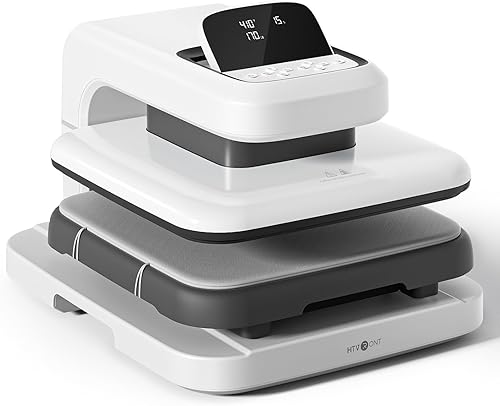
HTVRONT Auto Heat Press 2 15x15: Best for patch-covered backs and jackets
- 15 x 15 in plate
- Adjustable pressure up to 80 kg
- Presses items up to 1.77 in thick
- Heats to 410 F in about 5.5 mins
Extra height and adjustable pressure let it clamp thick denim jackets and hoodies where a patch needs real force.
Pros
- Higher pressing height for thick garments
- Pressure dial avoids light presses
- Auto press and release
Cons
- Heavy at 21.54 kg
- Large footprint for a small bench
The HTVRONT Auto Press 2 is the pick for thick garments and large patches. It presses items up to 1.77 in thick, so a denim jacket with a patch over a pocket seam or a heavy hoodie gets real contact instead of a light touch.
Pressure adjusts up to 80 kg, which stops the weak press that leaves a patch edge lifting after a week. The 15 x 15 in plate heats to 410 F in about 5 minutes 30 seconds, and the dual-tube engine holds the temperature steady across the full surface.
The screen tilts through 7 positions from 0 to 75 degrees so you can read it sitting down. Press the R button and the machine closes, holds, buzzes and releases on its own.
You can load the next garment while it works.
At 21.54 kg it's a bench fixture, not something you put away after each patch. If your patch work is mostly small logos on shirts, the mini presses above are faster to set up.
HTVRONT Auto Heat Press 15x15: Best for batches of patched shirts
- 15 x 15 in plate
- Auto thickness adjust up to 1 in
- Heats to 320 F in about 4 mins
- Drawer slide design
Pressing runs itself after you push the button, which suits a run of shirts with one patch each.
Pros
- Hands-free cycle
- Drawer keeps hands off the hot plate
- 4 fast modes plus custom modes
Cons
- 1 in thickness limit
- Heavier and slower than a mini press for one patch
This HTVRONT suits a run of shirts with one patch each. Push the drawer in, press R, and the press closes, adjusts to the garment's thickness up to 1 in, holds and releases on its own.
The drawer slide keeps your hands away from the hot plate, which matters when you're feeding a stack of shirts through in one sitting. It heats to 320 F in about 4 minutes and holds temperature evenly across the 15 x 15 in plate.
Four fast modes and two custom modes let you save a setting for a patch supplier's instructions and reuse it. Auto-off after 15 minutes idle covers the end of a long session.
Against the Auto Press 2 it gives up height and pressure control, but it does the same hands-free cycle for flat shirts. The drawer also takes wood signs and coasters up to 1 in thick.
Choose it if your patches go on tees and totes rather than denim.
Delclynee 15x15 High Pressure Clamshell: Best for heavy pressure on flat work
- 15 x 15 in plate
- 32 to 455 F range
- Adjustable pressure knob
- Threadable lower platen
A manual clamshell with real clamping force for patch adhesives that need high heat and firm pressure.
Pros
- 455 F ceiling
- Threadable platen for single-layer pressing
- Floating top platen balances uneven items
Cons
- Fixed base, no slide out
- Manual pressure means you set it by feel
Delclynee's clamshell is the manual option for buyers who want to set pressure by hand. The knob adjusts clamping force for patch adhesives that need a firm, sustained squeeze, and the top platen floats to balance across uneven seams.
Its 32 to 455 F range covers high-heat glues, and the threadable lower platen lets you slide just the shirt front under the plate so heat goes through one layer of fabric. The base has a stabilizing handle and a fitted pad cover that stops the mat shifting.
A 5-beep alert sounds when it reaches temperature or the timer ends, so you're not watching a dial. The fixed lower board is the main difference from a slide-out press: you load over the plate rather than pulling a drawer toward you.
Pick it for heavy, flat patch jobs where pressure matters. Our best clamshell heat press roundup has the wider set of manual presses.
Cricut AutoPress 2 15x15: Best for guided auto pressing
- 15 x 15 in plate
- Pressure up to 220 lb
- Presses materials up to 1.8 in
- Bluetooth settings from the app
The app sends heat and time settings to the press, which helps if you want a recipe for each patch type.
Pros
- Highest pressure rating here
- Presets for repeat projects
- Insulated base and auto-off
Cons
- App needs Bluetooth and internet
- Premium price tier
The Cricut AutoPress 2 suits buyers who want a recipe for each patch. The app sends temperature, time and pressure settings to the press over Bluetooth, so a new patch type doesn't mean guessing a starting point.
Pressure goes up to 220 lb, the highest here, and the press adjusts to materials up to 1.8 in thick. That combination handles a patch on a quilted jacket as easily as one on a cotton tee.
Hands-free Auto Mode runs the cycle, and 4 built-in presets can be customized. An insulated safety base, a full slide-out tray and auto-off cover the practical side.
It's rated for DTF, HTV including puff, Infusible Ink and sublimation, so the same press covers most patch backings.
The trade-off is dependence on the app: Bluetooth and a high-speed connection are needed for the guided settings. Without them you set the press manually.
Choose it if you like guided projects, and a simpler press if you'd rather turn a dial.
Horgelu 12x15 5-in-1 Press: Best for one press across shirts, mugs and caps
- 12 x 15 in Teflon plate
- Cap, mug and two plate presses
- 360-degree swing away arm
- Counting function
A combo press that swaps between flat patches and hats, mugs or plates without buying a second machine.
Pros
- Cap press included for hat patches
- Swing-away arm clears the plate
- Counter tracks repeat jobs
Cons
- Lowest score here
- 110 V only, needs an adapter abroad
Horgelu is the one-machine answer for a craft room with shirts, caps, mugs and plates in it. The 12 x 15 in Teflon plate handles flat patches, and the kit adds a 5.5 x 3 in curved cap press, a mug press and two plate presses.
The 360-degree swing-away arm lifts the heated plate clear of the work so you can arrange a patch without reaching around it. A counting function tracks how many pieces you've pressed, which helps on a batch of identical shirts.
Safety comes from an insulated cover over the plate, a slide table and a circuit protector that cuts power on a short. Two silicone mats rated to 750 F sit under the work.
It scores lowest here because it does many jobs rather than one well, and the 110 V machine needs a step-down adapter outside the US. The preset mode saves a temperature and time so a repeat run doesn't mean dialing in again.
Pick it if you want cap and mug pressing without buying three machines.
How these heat press machines for embroidered patches compare
The table below lines up plate size, temperature range and pressure so you can match a machine to your patch type. A small plate wins on finished garments, and a curved platen wins on hats.
| Product | Best for | Heat plate | Temp range | Power | Our score |
|---|---|---|---|---|---|
| Calogy Mini Heat Press | small patches on finished garments | 2.87 x 4.43 in | 284 to 356 F | 300 W | 9.7 |
| Delclynee Hat Heat Press Machine for Caps | patches on structured caps | 32 to 455 F | 550 W | 9.3 | |
| VEVOR 4-in-1 Heat Press Machine for Hats | mixed hat shapes | 104 to 410 F | 580 W | 9.1 | |
| Calogy Super Mini Heat Press Machine | tiny patches and corners | 284 to 410 F | 110 V plug | 9.0 | |
| HTVRONT Auto Heat Press 2 15x15 | patch-covered backs and jackets | 1500 W | 8.7 | ||
| HTVRONT Auto Heat Press 15x15 | batches of patched shirts | 120 V | 8.4 | ||
| Delclynee 15x15 High Pressure Clamshell | heavy pressure on flat work | 32 to 455 F | 1400 W | 7.8 | |
| Cricut AutoPress 2 15x15 | guided auto pressing | Up to 410 F | 7.6 | ||
| Horgelu 12x15 5-in-1 Press | one press across shirts, mugs and caps | 1250 W | 7.1 |
Our score weighs specs, features and buyer feedback against what you're shopping for. In this roundup, that's a press that holds a patch flat at the right temperature, on the garment shapes you actually own.
What plate size do you need for embroidered patches?
Match the plate to the patch, not the shirt. A plate wider than the patch presses the fabric around it, which can leave a shine or crush the weave beside the embroidery.
For a 2 to 3 in chest patch, the Calogy Mini's 2.87 x 4.43 in plate is right. For a 5 in back patch, a 15 x 15 in plate covers it in one pass and gives even heat across the whole adhesive.
Small plates for finished garments
The two Calogy presses cover patches up to about 4.5 in and detail work at edges and corners. They're the fast choice when the garment is already sewn and you can't lay it flat on a big plate.
The Super Mini's pointed tip is the one to reach for on collars and cuffs, where a square plate would overlap seams and press creases into the shirt.
Large plates for backs and jackets
A 15 x 15 in plate, as on the HTVRONT pair, Delclynee clamshell and Cricut, handles back patches and full fronts. You get one even press instead of several overlapping passes that can flatten stitching.
Our guide to the best 15x15 heat press covers that size in depth.
Do you need a swing away or clamshell press for patch work?
For flat garments, either works. For hats and thick items, the press design matters more than the label.
A swing away lifts the plate up and over on an arm, so you arrange the patch on an open surface. A clamshell opens like a book, and the plate stays above the work.
Swing-away arms shine on odd-shaped items and on a cluttered bench, because the hot plate clears the area you're working in. The Horgelu's arm swings fully clear, which is what lets its plate and mug attachments share one base.
Clamshells are simpler and often cheaper per inch of plate.
On caps, neither flat design fits the curve, so a curved-platen cap press is the better call. If you're weighing the two designs for shirts, our best swing away heat press roundup lays out the differences.
What temperature and pressure do embroidered patches need?
Most patch adhesives activate at 320 to 350 F for 15 to 20 seconds under firm pressure. Check the patch maker's instructions, because a high-melt glue may ask for 400 F and a heat-sensitive fabric may want the lower end.
Pressure matters as much as heat. A light press leaves the adhesive partly cured, and the patch edge lifts after a few washes.
That's why the adjustable-pressure presses here (HTVRONT Auto Press 2, Cricut, Delclynee clamshell) suit thick twill and denim.
Reading temperature ranges
A 284 to 356 F press covers standard iron-on patches. A 32 to 455 F or 104 to 410 F range gives room for high-melt glues and for backing off on delicate fabrics.
The two Calogy presses top out at 356 F and 410 F, so the step up to the Super Mini is worth it if your patch supplier lists a hotter cure.
Using a pressing cloth
Lay a thin cotton or Teflon sheet over the embroidery before you close the press. It keeps the plate clean, stops thread scorch and spreads heat into the patch edge where lifting starts.
Teflon sheets are consumables and need replacing once they wear through.
How do you press a patch onto a cap or a curved surface?
Use a cap press with curved platens, because a flat plate only touches the highest point of the crown. The Delclynee and VEVOR both curve the upper plate and hold the cap on a stretcher, so the whole patch contacts at once.
Center the patch on the lower platen, where the heating surface is flattest and largest. A quick test press on a scrap cap finds the temperature that cures the adhesive without scorching the fabric.
Rotating the cap for multi-angle work helps when the logo wraps toward the side. Leave the bill free to hang down on a compact cap press so it doesn't lift the crown off the plate.
The Delclynee's zero-rebound stretcher holds the cap in place through that rotation, so you aren't chasing it back into position between presses.
Which heat press suits a small craft business?
The hands-free auto presses make the most sense for volume, because the machine runs the cycle while you load the next garment. The HTVRONT Auto Press 15x15 and its Auto Press 2 sibling both close, hold and release on their own, and the Cricut adds saved presets.
A counting function, like the one on the Horgelu, helps track a batch of identical shirts. For a business pressing caps as well as shirts, a combo press or a dedicated cap press beside a flat press covers both.
Verdict
Buy the Calogy Mini Heat Press if you press patches onto finished shirts, bags and jeans, since its small plate lands on the patch and keeps the fabric around it clean. It's the best heat press machine for embroidered patches in the common case.
Pick the Delclynee Hat Heat Press if hats are your main work, the HTVRONT Auto Press 2 if your patches go on thick jackets, and the Cricut AutoPress 2 if you want app-guided settings for each new patch type. For a first look at cap pressing, start with our guide to the best heat press machine for hats.
Our top 3 picks at a glance
-
1
-
2
Best for patches on structured caps
Delclynee Hat Heat Press Machine for Caps
9.3/10 our score
See it on Amazon -
3
Best for mixed hat shapes
VEVOR 4-in-1 Heat Press Machine for Hats
9.1/10 our score
See it on Amazon
Frequently asked questions
Can you iron an embroidered patch on instead of pressing it?
A household iron can work on a flat cotton shirt, but it presses unevenly and you can't hold steady pressure. A heat press gives the patch adhesive a flat, even plate at a set temperature, so the bond is more consistent, especially on thick twill and denim.
What temperature melts embroidered patch adhesive?
Most iron-on patch backings activate between 300 and 350 F for about 15 to 20 seconds. Check the patch maker's instructions, since some use a glue that needs closer to 400 F, and cover the embroidery with a pressing cloth so the threads don't scorch.
Do I need a special press for hat patches?
Yes, a flat plate bridges the curve of a cap front and leaves the middle of the patch loose. A cap press with curved platens, like the Delclynee or VEVOR, follows the crown shape so the whole patch makes contact at once.
Can a heat press ruin an embroidered patch?
Too much heat can scorch polyester threads and melt a glue backing into the fabric around the patch. Start at the lower end of the range, use a pressing cloth over the embroidery, and test one patch on scrap fabric before pressing a finished garment.
How long do you press an embroidered patch?
Hold a mid-weight patch for 15 to 20 seconds at 320 to 350 F with firm pressure, then let it cool flat before moving the garment. Thin patches or heat-sensitive fabrics need the shorter end of that range, and a second short press helps on thick seams.